
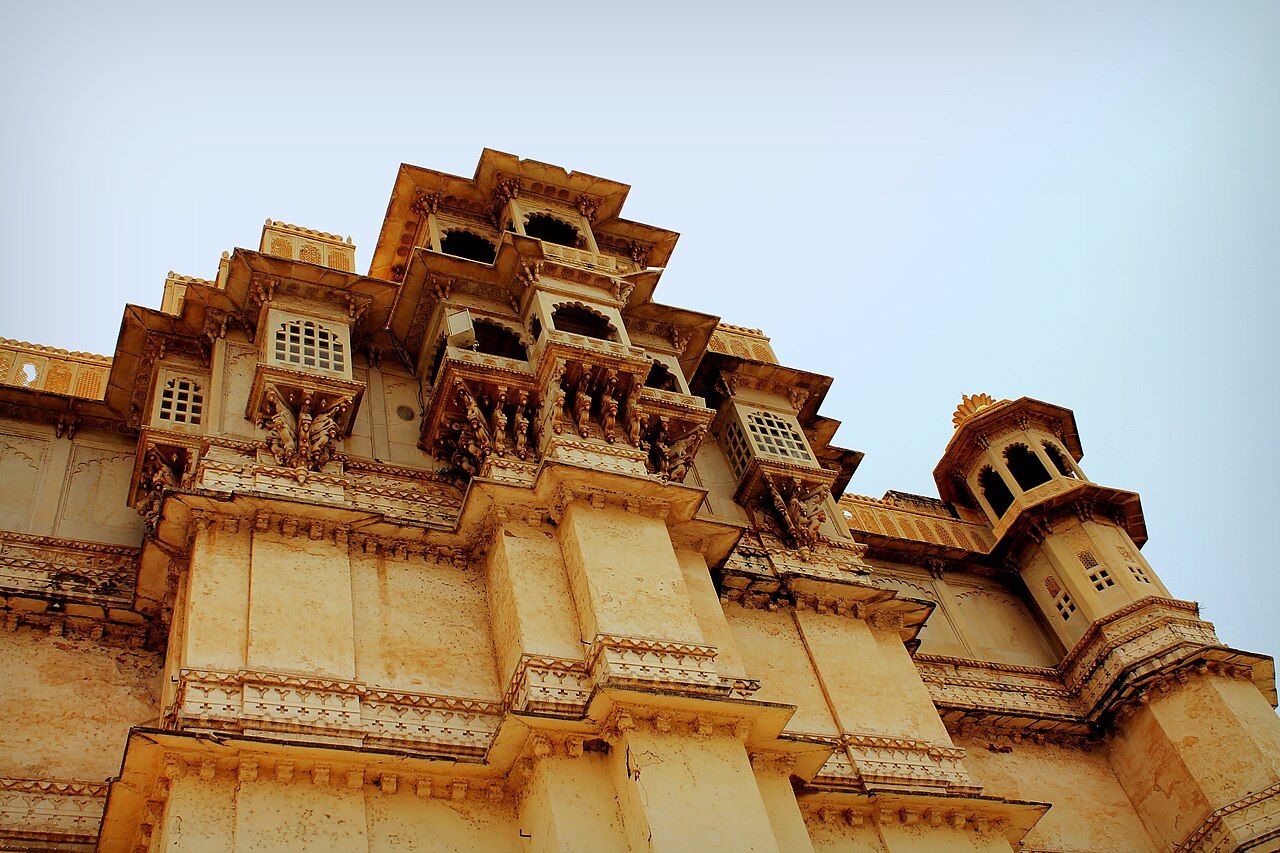
Road noteInside old Udaipur: lanes are narrow and parking near the gates is scarce, so walk or take an auto-rickshaw. Expect steep stairs inside.
The City Palace does not announce itself from the street so much as rise over it. From the lanes of old Udaipur you see a long cream wall, then balconies, then domes and cupolas crowding the skyline along the ridge, and only once you are inside do you understand how much of it there is. It runs along the east bank of Lake Pichola, and it was not built in one go. Each ruler of Mewar added rooms, courtyards and terraces over about four hundred years, and the joins are part of the pleasure.
A capital that started over
Udaipur itself is a second beginning. In 1559 Maharana Udai Singh II founded the city as a new capital for Mewar, away from Chittorgarh, the old hill fortress that had been besieged more than once. The site he chose had water, hills on every side and a lake that could be enlarged. The palace grew from those first buildings on the ridge, and his successors kept going: a wing here, a courtyard there, a new storey of balconies looking west over the water.
That slow growth explains the feel of the place. It is less one grand plan than a long conversation between generations of builders, in which Rajput habits of defence meet the softer manners of later courts. Corridors twist and narrow without warning, staircases are steep and low-ceilinged, and then a door opens on to a bright courtyard or a window full of lake. The narrow passages were meant to slow down anyone who arrived uninvited. They still slow you down, which is no bad thing.
Through the gates and up
Most visitors come in from the north, through the big ceremonial gateways and across a wide forecourt where the city's noise falls away. The triple-arched Tripolia gate is the one people remember. Beyond it the museum entrance leads you up and in, and from here the route is largely one-way: you follow the arrows, climbing through the older core of the palace towards the upper courtyards.
Go early. The palace is one of the most visited places in Rajasthan, and from mid-morning the inner corridors fill with school groups and tour parties moving in tight knots. In the first hour after opening you can stand in a courtyard and hear pigeons. Later you will be shuffling. Opening hours, ticket rules and camera charges change from time to time; expect a small fee for entry and perhaps another for a camera.
Wear shoes you can walk in and carry water. The climb is not long, but it is all stairs, and some are worn smooth. If you have trouble with steps, take your time and use the rails; there is no hurry, and the best rooms are near the top.
The zenana and Lakshmi Chowk
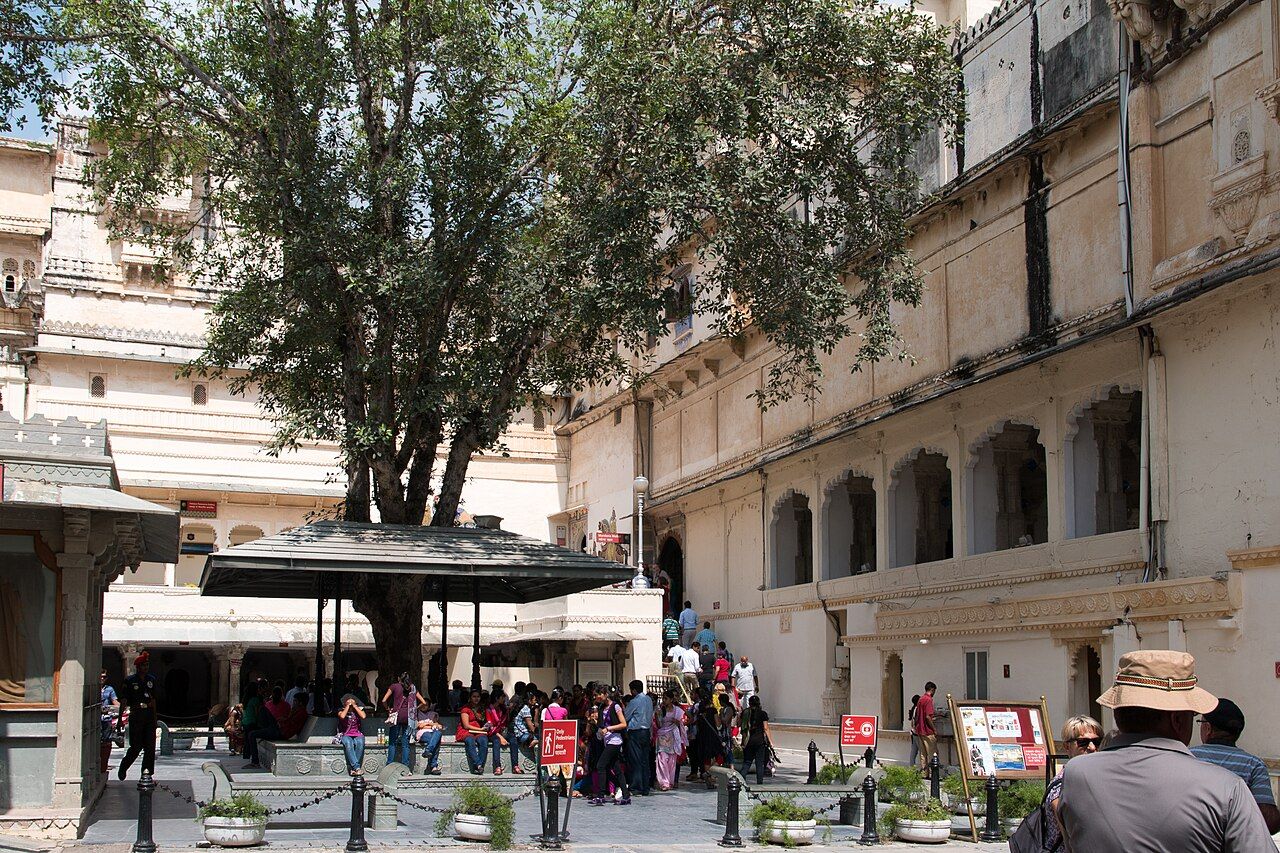
One of the larger open spaces is Lakshmi Chowk, the courtyard of the zenana, the women's quarters. It is broad and shaded by a big tree, with arcades along one side and the upper storeys of the palace looming over it. Here, more than anywhere, you sense how many people once lived inside these walls, and how much of their lives was spent looking inward at courtyards rather than out at the city.
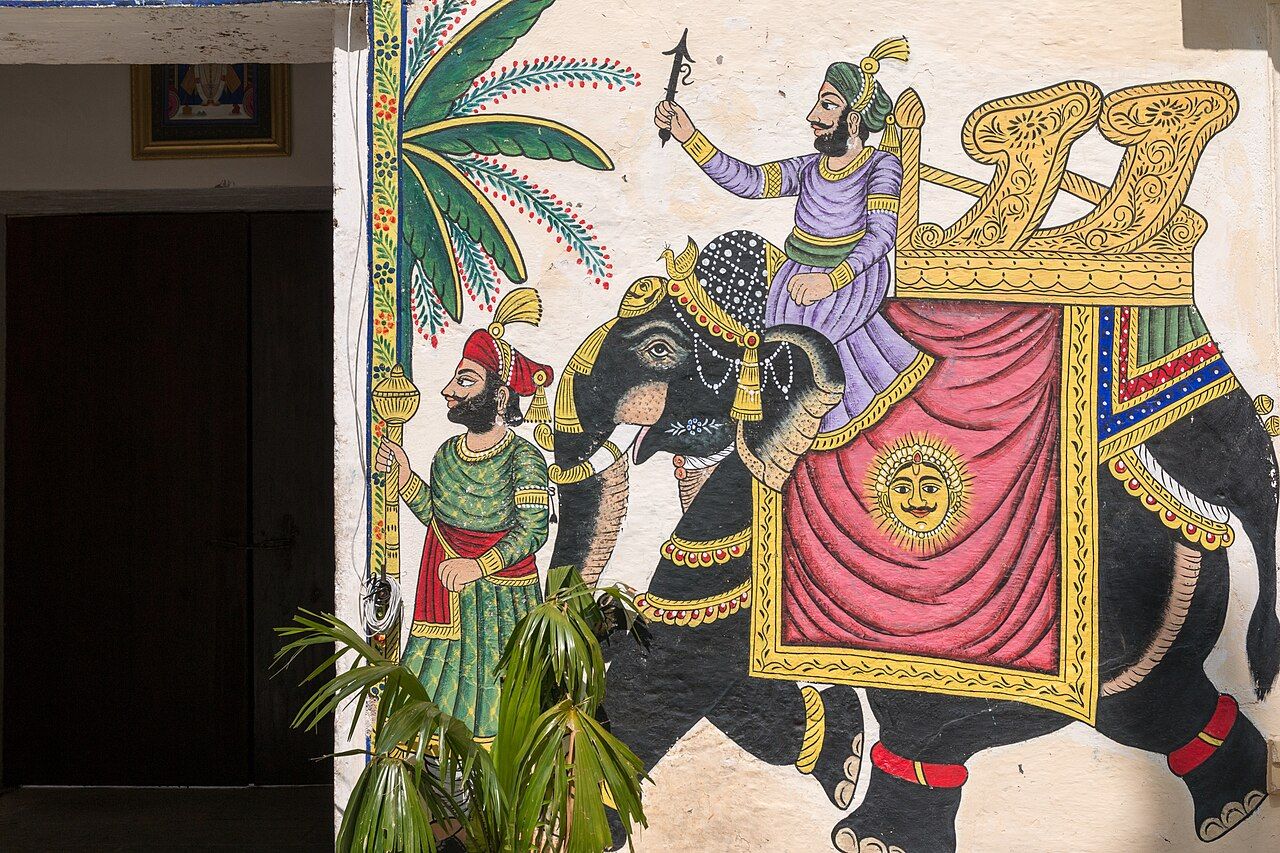
The walls around the palace carry painted scenes in the old Mewar style: processions, horses, elephants in full ceremonial dress. Near the entrance to the zenana courtyard an elephant strides across a whitewashed wall with a rider on its back and an attendant walking alongside. These paintings are refreshed over the years, as they always have been, so do not worry about whether a given brushstroke is old; look at the conventions instead, the profile faces, the flat bright colours, the careful patterning of cloth.
If you are planning a longer stay in Mewar, the palace makes a good first morning. It gives you the vocabulary of jharokhas, chhatris and painted walls that you will meet again at the hill fort of Kumbhalgarh and on the hilltop at the Monsoon Palace.
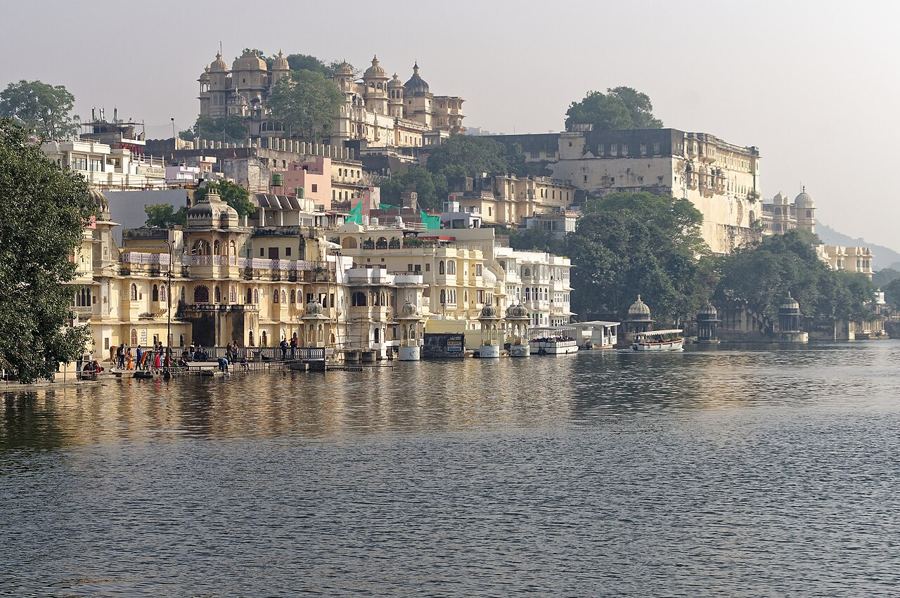 Worth the detour · UdaipurLake Pichola and the ghats of old Udaipur
Peacocks and mirrors
Higher up comes the courtyard most people have come for. Mor Chowk, the peacock courtyard, is lined with niches and balconies set with coloured glass mosaic, and the peacocks themselves, worked in blue and green glass, spread their tails across the walls. The colours change as the light moves. In the morning the blues are deep and cool; by afternoon the courtyard glitters and the crowds make it hard to stand back far enough to see the whole wall.
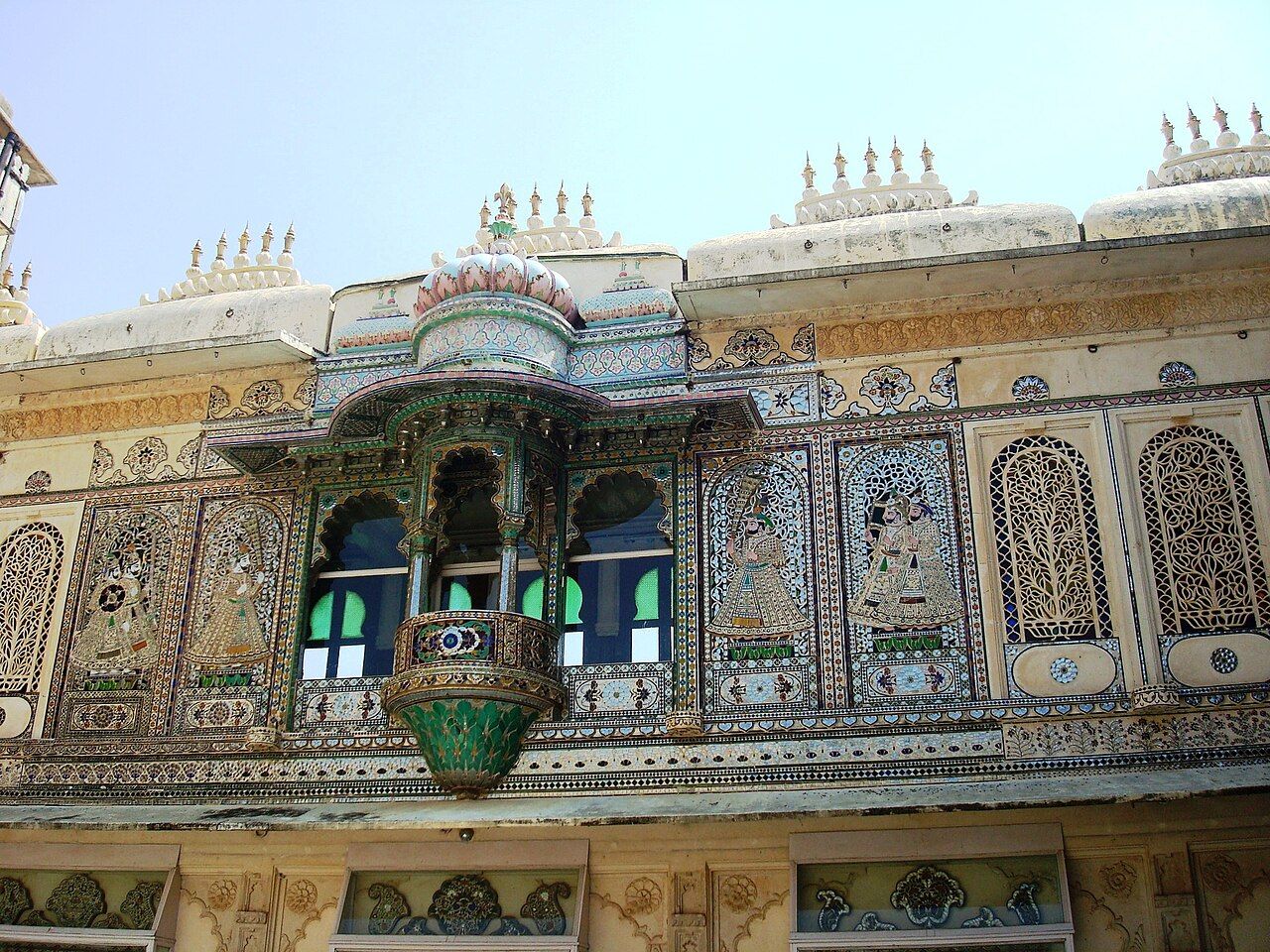
Look closely and you will see the craft is not only peacocks. There are panels of figures, flowering trees, inlaid borders, little rounded mirrors set into plaster. Elsewhere in the palace whole rooms are given over to mirror and glass work, small chambers where every surface catches a candle's worth of light. The rooms were made to be seen by lamplight; in daylight they look busier, but you can still imagine them at night.
The museum sections also hold paintings, weapons, household objects and furnishings from the Mewar court. Labels are mostly brief. It helps to read a little about the history of Mewar before you go, so that names like Udai Singh and Pratap mean something when they appear on the walls.
The colours change as the light moves.
Windows on the lake
Every so often the route spits you out on a terrace or a small balcony, and there is the lake. From the upper floors you look straight down at the water and across to the island palaces: Jag Mandir lower and further off, and the white palace on the water closer to shore. On a clear winter morning the hills on the far side are sharp and blue. These views are why you climbed.
The palace and the lake below it belong together, and they are best taken on the same day: the palace in the morning, the lake in the late afternoon, when the light swings round and the city's west-facing walls turn gold. Boats for the lake leave from the palace side, and you will see the jetties from the terraces.
A palace still lived in
Not all of the complex is museum. Part of it is still associated with the former royal family of Mewar, who keep a presence in the palace and in the city's ceremonial life, and some wings serve other purposes. You will pass doors you cannot open and courtyards you can only glimpse. That is worth remembering when the corridors feel like a theme park: this is a working palace, not a reconstruction.
When you come out, give yourself time in the forecourt and the lanes below. The streets that run down from the palace gates towards the ghats and the Jagdish temple are among the oldest in Udaipur, and they make a slower, quieter end to the morning. If you are heading on north into the hills afterwards, the road towards the Jain temple at Ranakpur begins just outside the city.
Next in Mewar: Lake Pichola and the ghats of old Udaipur