
Road noteAbout an hour by car from Sikar on the main road towards Bikaner, heavy with trucks. Park near the old town, walk the lanes.
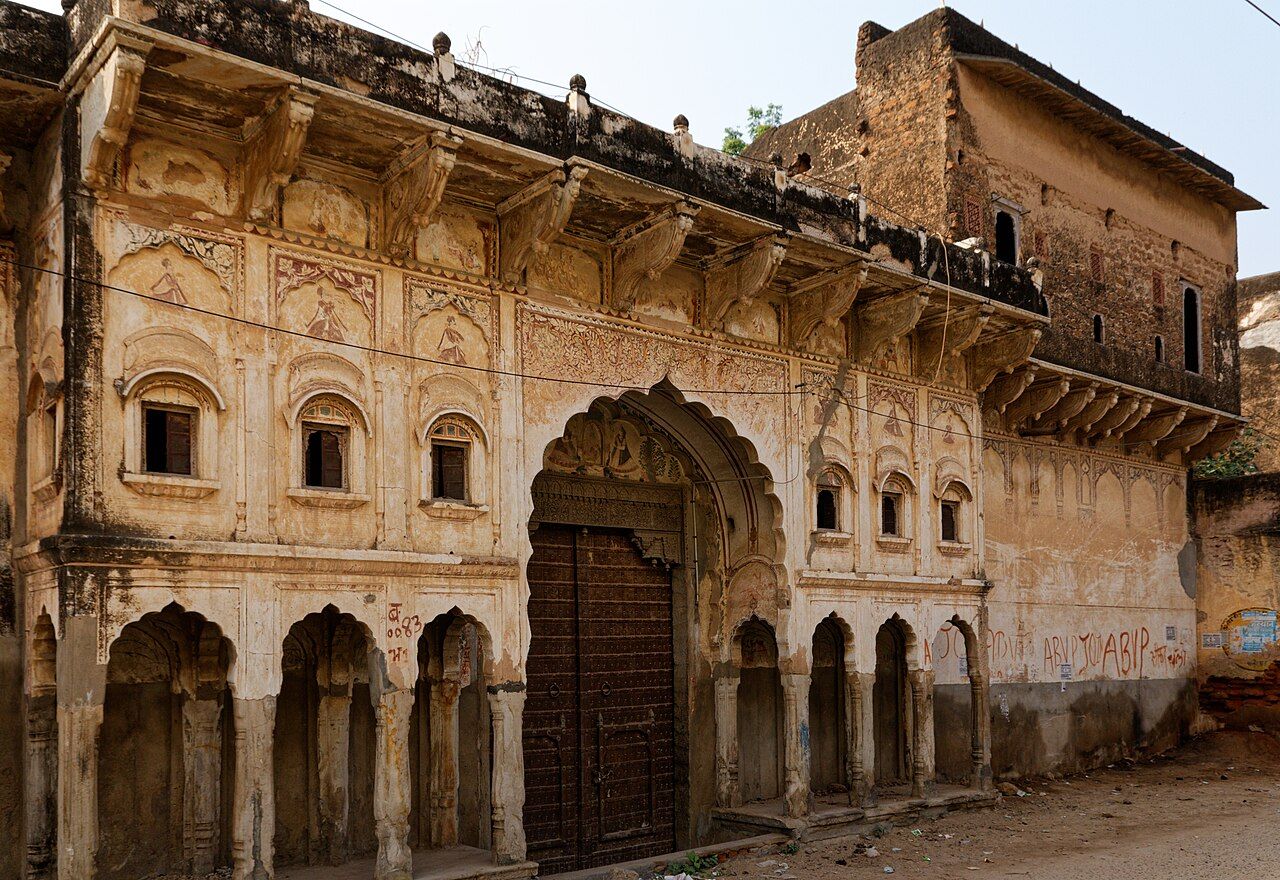
Fatehpur does not announce itself as a place of art. It sits on the main road between Sikar and Bikaner, and the first thing you meet is traffic: trucks, buses, tractors and motorbikes, shops and workshops along the highway. Turn off into the older lanes, though, and the painted walls begin. Within a few minutes the noise drops away and you are walking past havelis whose facades are covered with gods, horsemen, flowers and scenes from a world that has largely moved elsewhere.
It is often called Fatehpur Shekhawati, to tell it apart from Fatehpur Sikri near Agra and the many other Fatehpurs in India. It is one of the larger towns of the painted region and one of the oldest.
An older town than its neighbours
Fatehpur was founded in 1451 by Fateh Khan, of the Kaimkhani Nawabs, a Muslim ruling family who held this part of the region before the Shekhawat Rajputs took control in the 18th century. Most of the painted towns of Shekhawati are much younger. Fatehpur already had centuries of history when its merchant families began to grow rich.
That wealth came the same way as elsewhere in the region. Marwari traders profited from the caravan routes across this semi-desert, and in the 18th, 19th and early 20th centuries many moved their business to Calcutta and Bombay while keeping their family homes here. They spent their fortunes on havelis, temples, wells and memorials, and they paid painters to decorate them inside and out.
Havelis to look for
The old town holds a large number of painted havelis, some still in good condition, many faded, some close to collapse. Among the better known are the Jalan and Devra havelis, whose walls carry the mix of subjects typical of Shekhawati: Hindu gods and the stories of Krishna, processions and battle scenes, and, on later work, the new wonders that the merchants saw in the cities, such as trains, motor cars and European figures in hats and frock coats.
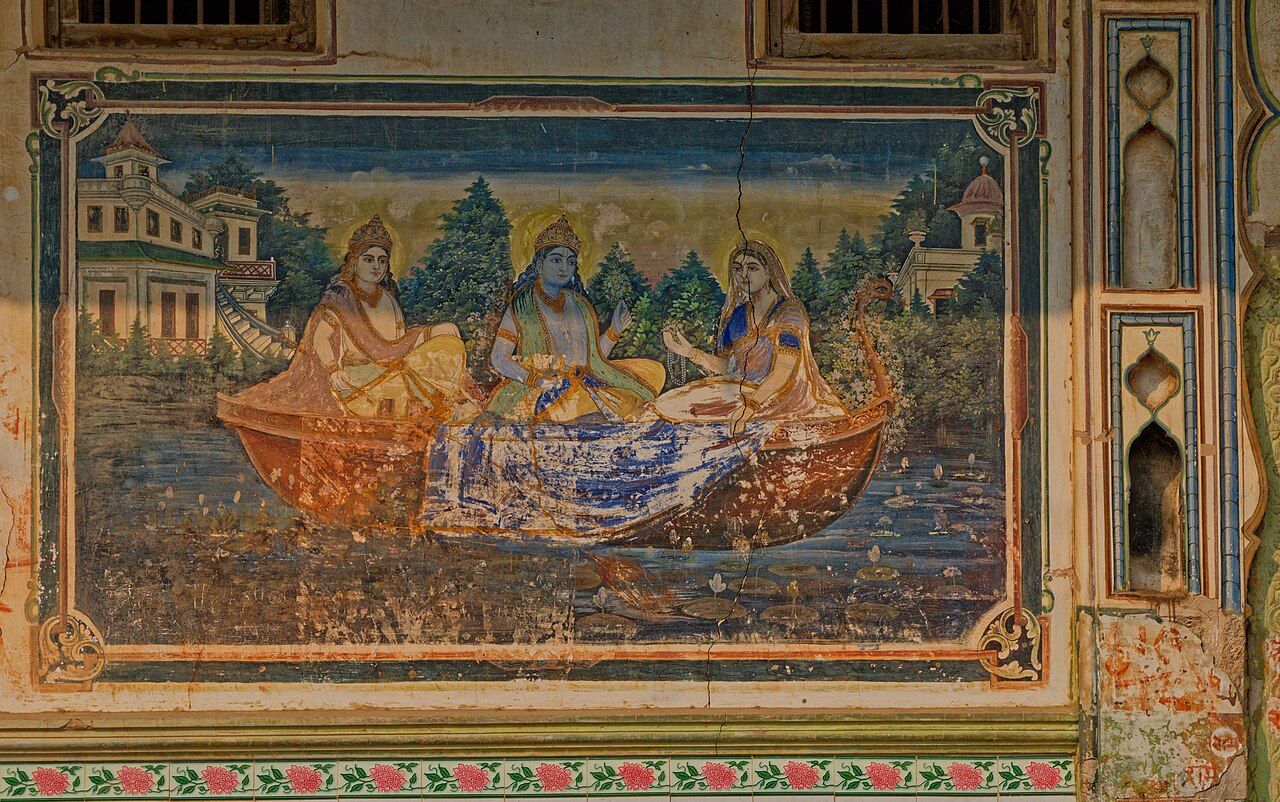
Look closely at the panels you pass. Many are framed like pictures, with painted borders and small architectural details, and some show buildings in the background that mix Rajasthani domes with European balconies and staircases. Cracks run straight through some of them, and the lower parts of many walls have been scraped or stained by years of street life. Look up, too: the best-preserved painting often sits high under the eaves, where hands and rain reach less.
Most havelis are private and locked, with their owners living far away. Where a caretaker is present, you may be shown a courtyard for a small fee. Always ask before entering, and do not assume an open door is an invitation.
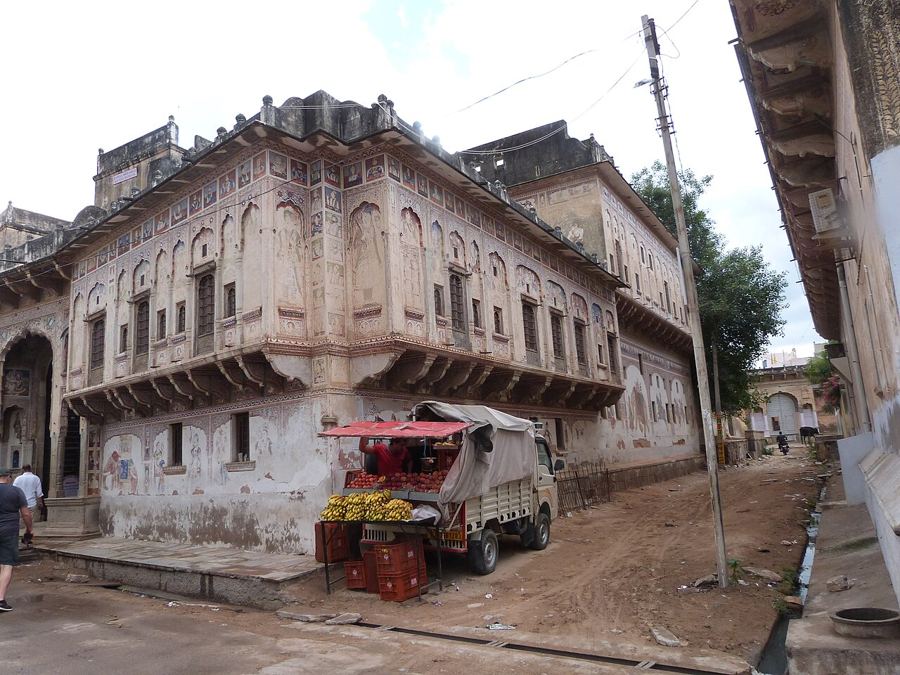 Worth the detour · NawalgarhNawalgarh's havelis and fresco museums
A haveli turned cultural centre
One haveli in Fatehpur has had a very different fate from its neighbours. The Nadine Le Prince Haveli was bought and restored by a French artist and now works as a cultural centre, with exhibitions and space for artists. Seeing it gives you an idea of what these houses looked like when they were cared for: clean courtyards, bright panels, carved doors that open and close properly.
Even if you only see it from the lane, it makes a useful contrast with the unrestored houses around it, and it shows that restoration here is possible when someone has the means and the patience.
The step-well
Fatehpur's baori, or step-well, is a reminder of how much these towns depended on stored water. A step-well is a deep, stepped shaft that lets people reach the water table as it rises and falls through the year, with landings, galleries and arches built into the sides. In a dry region they were wells, cool retreats and places to meet all at once.
The Fatehpur baori is in poor repair. Parts of the structure have collapsed, and rubbish has gathered in places. It is still worth seeing for its scale and the lines of its steps, but treat it with care: stay away from crumbling edges, do not climb down where the stone is loose, and keep a close eye on children. Closed shoes are better than sandals here.
Practical notes for a visit
Half a day is enough to walk the old lanes and see the step-well from its edge. A full day lets you add the cultural centre and a slower look at more havelis. Start early: by late morning the lanes heat up and the light turns flat, and in the hot months from April to June the middle of the day is hard going. The comfortable season runs roughly from October to March.
- Ask before photographing people, and before entering any courtyard.
- Carry water; shade in the old town is patchy.
- Small notes are useful for caretakers who open a haveli.
- Expect traffic on the main road; the lanes inside are slower and calmer.
Fatehpur on the wider circuit
Fatehpur makes a good hinge for a Shekhawati loop. Mandawa lies a short drive to the east, and Ramgarh, with its painted chhatris, about 20 km to the north. Because it sits on the main road towards Bikaner, it also links the painted towns with the desert: you can carry on west to Junagarh Fort in Bikaner and the towns beyond.
The distances in the region are short, but driving is slower than maps suggest, with trucks on the highway and cattle on the smaller roads. Our page on getting around Rajasthan by road has more on planning realistic days. Base yourself in the region for two or three nights and you can see Fatehpur in the cool of a morning, rather than squeezing it into a long transit day.